
Last Updated on 08/08/2026 by Mark Verhoeven
Adjustable-Rate Mortgage ARM: Index, Margin, Rate Caps, and Adjustment Period
Adjustable-Rate Mortgage ARM loans start with one interest rate and then adjust after a set introductory period ends. Borrowers choose this loan type when they want a lower starting payment than a comparable fixed-rate mortgage offers. Mortgage Rates Today tracks ARM pricing daily so shoppers can compare an adjustable-rate mortgage against fixed-rate options before they apply. The Mortgage Bankers Association reports ARM applications made up 8.5% of total mortgage activity for the week ending May 29, 2026, and the average 5/1 ARM rate stood near 5.8% in June 2026. Lenders index this loan type to SOFR, the Secured Overnight Financing Rate, or to Treasury benchmarks. This guide explains how the index, margin, caps, and adjustment period shape an adjustable-rate mortgage ARM payment over time.
Contents
- What is an Adjustable-Rate Mortgage ARM?
- What are the Types of Adjustable-Rate Mortgage ARM?
- What is the Benefit of an Adjustable-Rate Mortgage ARM?
- How Does an Adjustable-Rate Mortgage ARM Work?
Show more
- What is the Importance of an Adjustable-Rate Mortgage ARM?
- What is the Initial Rate Period on an Adjustable-Rate Mortgage ARM?
- How Do Interest Rate Caps Work on an Adjustable-Rate Mortgage ARM?
- What Index and Margin Apply to an Adjustable-Rate Mortgage ARM?
- What is the Adjustment Period for an Adjustable-Rate Mortgage ARM?
- What is a Teaser Rate on an Adjustable-Rate Mortgage ARM?
- What Credit Score is Needed for an Adjustable-Rate Mortgage ARM?
- Can You Convert an Adjustable-Rate Mortgage ARM to a Fixed Rate?
- What is Payment Shock on an Adjustable-Rate Mortgage ARM?
- What is a 5/1 Adjustable-Rate Mortgage ARM?
- How Does an Adjustable-Rate Mortgage ARM Compare to a Fixed-Rate Mortgage?
Overview
What is an Adjustable-Rate Mortgage ARM?
An adjustable-rate mortgage ARM is a home loan whose interest rate changes after an initial period. Lenders set a low introductory rate for the first years, then adjust the rate based on a published index. As stated by the Federal Reserve Board, margins on adjustable-rate mortgages are almost always between 1.75 and 2.5 percentage points. An adjustable-rate mortgage ARM carries a variable rate, unlike the fixed interest rate on a traditional home mortgage loan, and the rate remains fixed only during that initial period. Borrowers accept future rate uncertainty in exchange for lower monthly payments at the start of the loan term.
What are the Types of Adjustable-Rate Mortgage ARM?
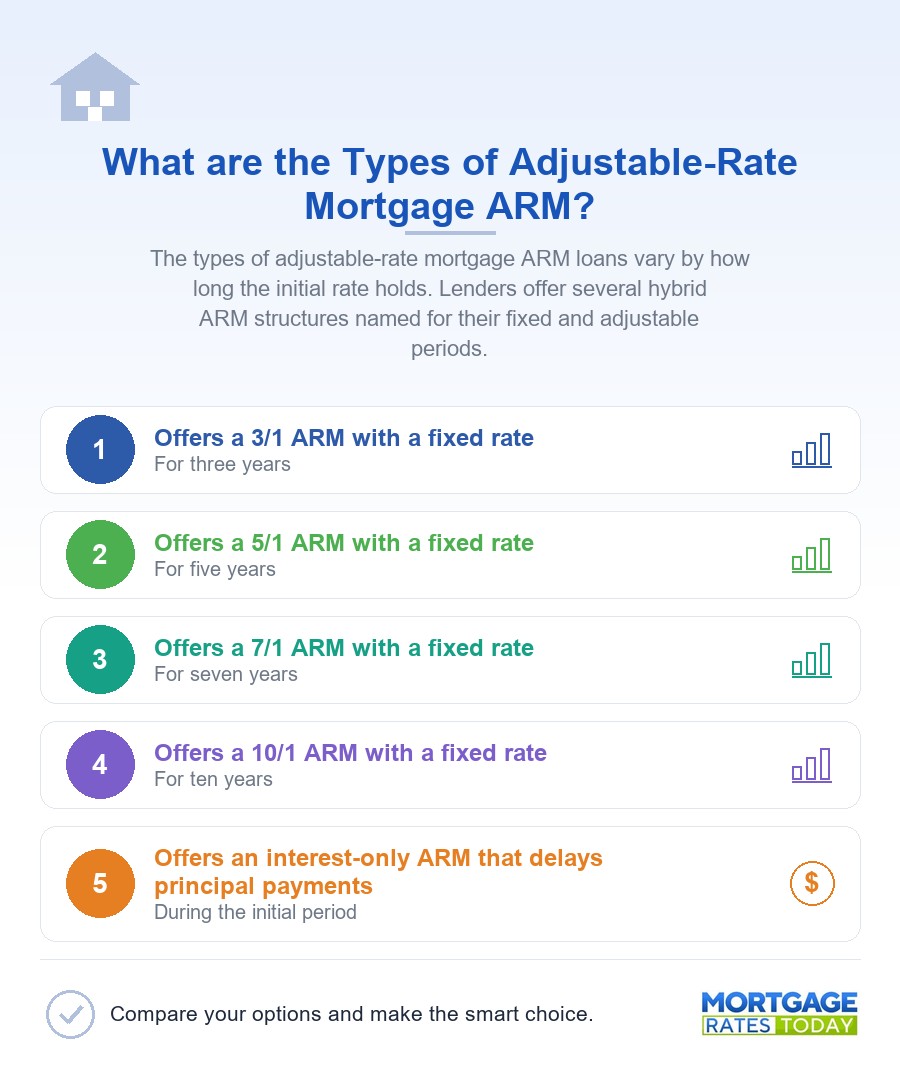
The types of adjustable-rate mortgage ARM loans vary by how long the initial rate holds. Lenders offer several hybrid ARM structures named for their fixed and adjustable periods.
- Offers a 3/1 ARM with a fixed rate for three years
- Offers a 5/1 ARM with a fixed rate for five years
- Offers a 7/1 ARM with a fixed rate for seven years
- Offers a 10/1 ARM with a fixed rate for ten years
- Offers an interest-only ARM that delays principal payments during the initial period
Many lenders also offer interest-only arms and hybrid arms as a mortgage option for qualified borrowers, and many arms include a minimum rate floor. Hybrid arms offer borrowers a lower initial rate than fixed loans, and a 5/1 ARM remains a good option for buyers planning to move or refinance within several years. The first seven years of a 7/1 ARM hold one fixed rate, and some lenders still market a 5-year ARM or 7-year arms using older naming conventions.
What is the Benefit of an Adjustable-Rate Mortgage ARM?
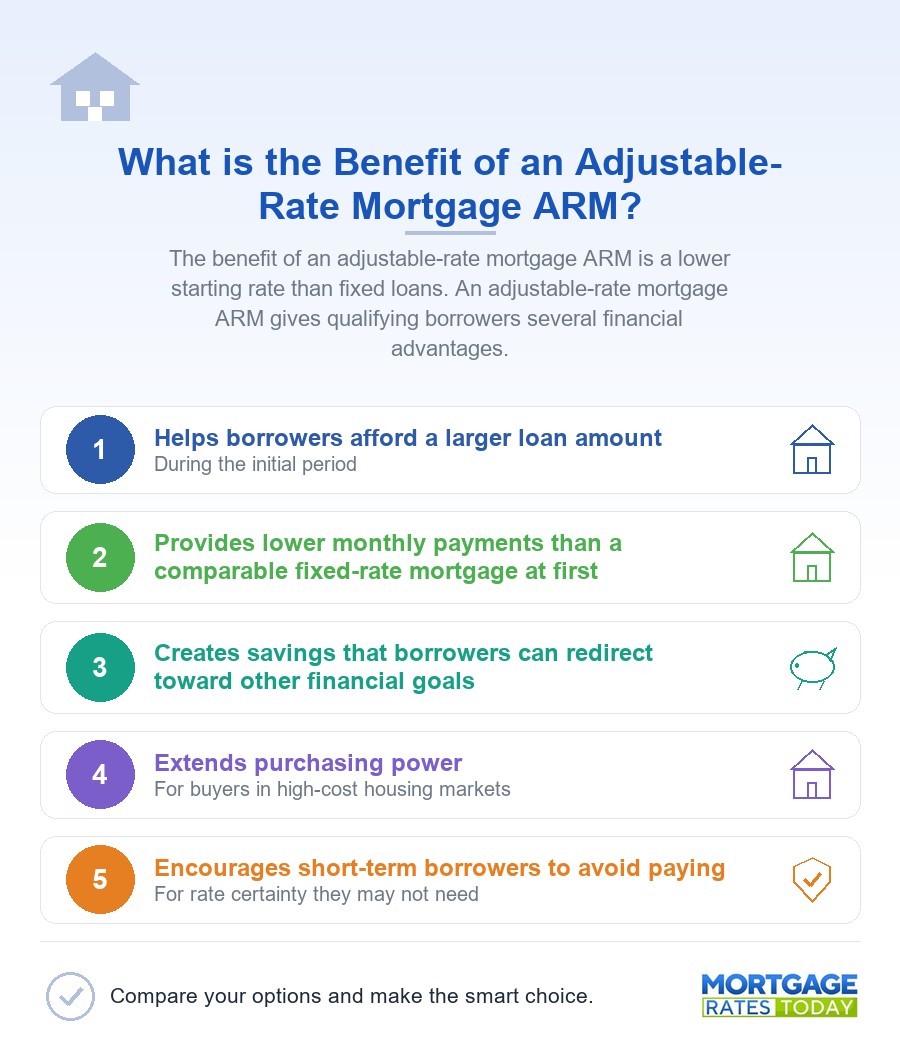
The benefit of an adjustable-rate mortgage ARM is a lower starting rate than fixed loans. An adjustable-rate mortgage ARM gives qualifying borrowers several financial advantages.
- Helps borrowers afford a larger loan amount during the initial period
- Provides lower monthly payments than a comparable fixed-rate mortgage at first
- Creates savings that borrowers can redirect toward other financial goals
- Extends purchasing power for buyers in high-cost housing markets
- Encourages short-term borrowers to avoid paying for rate certainty they may not need
An adjustable-rate mortgage ARM can also improve cash flow and free up funds for other personal financial goals.
Work
How Does an Adjustable-Rate Mortgage ARM Work?
An adjustable-rate mortgage ARM works by combining a fixed introductory period with periodic rate resets. The lender ties the rate to an index, adds a fixed margin, and recalculates the payment at each adjustment. As per Federal Reserve research, the interest rate can change monthly on about 15% of ARMs and annually on 50% to 60% of ARMs. Rising index values push the fully indexed rate higher at each adjustment, depending on market conditions at that time. Lenders calculated each new payment amount using the current index plus the added margin, and the resulting rate stays fixed until the following reset. Borrowers moving through the initial period should expect a changing payment once the adjustable phase begins, and many arm rates are allowed to rise only within a given cap. An estimated share of ARM borrowers underestimate how much a growing payment can climb once adjusting begins at the beginning of the reset schedule.
Importance
What is the Importance of an Adjustable-Rate Mortgage ARM?
The importance of an adjustable-rate mortgage ARM lies in matching loan cost to borrower timelines. Short-term buyers save money by avoiding the rate premium that fixed-rate mortgages charge for decades of certainty. According to ICE Mortgage Technology, roughly 831,000 ARM loans reset between March 2023 and March 2024, and more than 70% of those borrowers saw their rate rise by two percentage points or more. Rate increases can raise interest payments quickly, so a well-prepared borrower reviews the determined adjustment schedule before taking on this loan. A written disclosure is given to every borrower once the loan has been taken to closing, and related loan fees may apply depending on the lender.
Initial Rate Period
What is the Initial Rate Period on an Adjustable-Rate Mortgage ARM?
The initial rate period on an adjustable-rate mortgage ARM sets how long the starting rate lasts. As reported by the Mortgage Bankers Association, hybrid ARM products remain named for this initial period length. The initial interest rate on a shorter ARM structure often beats a longer fixed period, though pricing can vary by lender. Borrowers looking for the lowest initial rate benefit from getting quotes from many lenders before choosing an ARM. The table below compares common initial rate periods and their typical structure.
| ARM Type | Initial Rate Period | Adjustment Frequency After |
|---|---|---|
| 5/1 ARM | 5 years | Once per year |
| 7/1 ARM | 7 years | Once per year |
| 10/1 ARM | 10 years | Once per year |
A longer initial period usually carries a higher starting rate than a shorter one, though still below most fixed-rate mortgage pricing.
Interest Rate Caps Work
How Do Interest Rate Caps Work on an Adjustable-Rate Mortgage ARM?
Interest rate caps on an adjustable-rate mortgage ARM work by limiting how much a rate can rise. Lenders publish a cap structure with three numbers covering the first adjustment, later adjustments, and the lifetime limit. As noted by Federal Reserve subprime-ARM research, the first-adjustment interest rate cap averaged 2.5 percentage points at origination in the loans studied.
| Cap Type | Typical Limit | Applies To |
|---|---|---|
| Initial adjustment cap | 2 to 5 percentage points | First rate reset only |
| Subsequent adjustment cap | 2 percentage points | Each later reset |
| Lifetime cap | 5 to 6 percentage points | Entire loan term |
A lifetime cap keeps the rate from rising above a fixed ceiling for a set period after each adjustment, and a rate floor keeps the rate fluctuates within these caps for the entire remaining loan term. A 2/2/5 cap structure remains the most common cap arrangement offered on conforming ARM loans today.
Index And Margin Apply
What Index and Margin Apply to an Adjustable-Rate Mortgage ARM?
The index and margin on an adjustable-rate mortgage ARM together set the adjusted interest rate. Lenders combine one published index with a fixed margin to calculate each new rate.
- Uses the Secured Overnight Financing Rate, called SOFR, for most current ARM loans
- Uses the one-year Constant Maturity Treasury, or Treasury CMT, on some ARM loans
- Uses the eleventh-district Cost of Funds Index, an index COFI-based structure, on older ARM loans
- Adds a margin of 1.75 to 2.5 percentage points to the index rate
- Adjusts the fully indexed rate whenever the underlying index rate changes
SOFR index data comes from the Federal Reserve Bank of New York, which publishes the rate daily and helps set the arm interest lenders charge. The prime rate and rate sofr benchmarks both influence how lenders price a variable rate loan.
Adjustment Period
What is the Adjustment Period for an Adjustable-Rate Mortgage ARM?
The adjustment period for an adjustable-rate mortgage ARM sets how often the rate resets. Most ARM loans adjust once per year after the initial period ends, though some adjust every six months. Rate adjustments follow a set period defined in the loan documents, and the annual percentage rate can change at every adjustment following that schedule. The table below shows how adjustment frequency varies by ARM structure.
| ARM Structure | Adjustment Frequency | Common Index |
|---|---|---|
| Traditional ARM | Every six months | SOFR or Treasury CMT |
| Hybrid ARM | Once per year | SOFR |
| Interest-only ARM | Once per year after interest-only period | SOFR or Treasury CMT |
Borrowers should confirm the exact adjustment period and index in their loan estimate before closing.
Teaser Rate
What is a Teaser Rate on an Adjustable-Rate Mortgage ARM?
A teaser rate on an adjustable-rate mortgage ARM is a discounted starting rate below the fully indexed rate. Lenders offer this introductory rate to attract borrowers, and the rate typically holds for the initial fixed-rate period only. As cited by Federal Reserve research on subprime ARMs, initial rates often sit well below the index plus margin during origination. A low starting rate helps a borrower take advantage of short-term savings before the rate adjusts higher at the first reset. Borrowers should calculate the fully indexed rate before applying so the first adjustment does not create payment shock.
Credit Score Is Needed
What Credit Score is Needed for an Adjustable-Rate Mortgage ARM?
The credit score needed for an adjustable-rate mortgage ARM starts around 620 for conventional loans. Minimum credit score requirements for an adjustable-rate mortgage ARM vary by loan program.
- Requires a 620 credit score for most conventional ARM loans
- Requires a 580 credit score for an FHA adjustable-rate mortgage with 3.5% down
- Requires no set minimum for VA loans, though lenders often prefer 620
- Requires a higher credit score for jumbo ARM loan amounts above conforming limits
- Requires a low debt-to-income ratio alongside a qualifying credit score
VA loans are guaranteed by the Department of Veterans Affairs, and FHA loans are insured by the Federal Housing Administration. Both required programs connect borrowers to a lending resource center for support.
Convert Fixed Rate
Can You Convert an Adjustable-Rate Mortgage ARM to a Fixed Rate?
Borrowers can convert an adjustable-rate mortgage ARM to a fixed rate through refinancing. Refinancing lets a borrower lock a new fixed rate before the ARM’s first adjustment arrives. Borrowers get started on a conversion by contacting their lender and requesting new fixed terms, and jumbo loans often carry different fixed period rules than conforming loan rate structures. As indicated by Urban Institute chartbook data, ARM share of new originations moves with the gap between ARM and fixed-rate mortgage pricing. Some lenders offer a built-in conversion option that skips a full refinance and its closing costs.
Payment Shock
What is Payment Shock on an Adjustable-Rate Mortgage ARM?
Payment shock on an adjustable-rate mortgage ARM happens when the rate resets sharply higher. Several factors determine how large a payment shock a borrower may face at reset.
- Raises the payment when the index rate climbs before the adjustment date
- Raises the payment when the loan hits its maximum adjustment cap
- Raises the payment when a borrower ignores the fully indexed rate at closing
- Lowers the payment risk when a borrower refinances before the first reset
- Lowers the payment risk when rate caps keep the increase small
Home equity built during the initial period gives borrowers more refinance options if a rate increases sharply. Payment options like a rate-and-term refinance can offset an increased payment when the adjustable-rate loan resets. As referenced by ICE Mortgage Technology data, resetting borrowers saw their average rate climb from 5.64% to 7.55%, a typical monthly payment increase near $174.
5/1
What is a 5/1 Adjustable-Rate Mortgage ARM?
A 5/1 adjustable-rate mortgage ARM holds one rate for five years, then adjusts yearly. The average 5/1 ARM rate stood near 5.8% in June 2026, according to Mortgage Bankers Association survey data. Borrowers comparing loan types should also weigh total interest paid over the full loan rate term against monthly principal and initial monthly savings. An interest-only arms option can lower the initial payment further during the first years of a 5/1 ARM. The table below compares a 5/1 ARM against a 30-year fixed-rate mortgage on a $400,000 loan amount.
| Loan Type | Initial Rate | Monthly Payment (Initial) |
|---|---|---|
| 5/1 ARM | 5.80% | $2,352 |
| 30-year fixed-rate mortgage | 6.58% | $2,552 |
The 5/1 ARM saves roughly $200 per month during the initial period before its first adjustment.
How Does an Adjustable-Rate Mortgage ARM Compare to a Fixed-Rate Mortgage?
An adjustable-rate mortgage ARM compares to a fixed-rate mortgage mainly through rate risk over time. Industry materials sometimes label these loan products mortgages ARMs interchangeably, and some borrowers frame the choice simply as ARM vs fixed-rate when they compare loan rate options side by side. The two loan types differ in several ways that matter to borrowers.
- Starts lower on an adjustable-rate mortgage ARM than on a fixed-rate mortgage
- Stays fixed for a fixed-rate mortgage across the entire remaining term
- Adjusts periodically for an adjustable-rate mortgage ARM once the initial period ends
- Carries payment-shock risk on an adjustable-rate mortgage ARM when rates rise
- Suits long-term homeowners best when compared with a short-term ARM borrower
An adjustable-rate loan, sometimes called an adjustable rate loan or one of several adjustable rates programs, still needs careful comparison, and negative amortization risk on some ARM products remains a reason many still prefer a fixed-rate mortgage. A lower interest rate and lower rate structure early on can help borrowers pay off other debt while interest rates stay low relative to market rates. In accordance with FHFA National Mortgage Database figures, ARMs account for just 3.5% of outstanding mortgages nationwide, down from 9.6% a decade earlier, while fixed-rate loans dominate the remaining market.
Choosing an adjustable-rate mortgage ARM over a fixed-rate mortgage depends on how long a borrower plans to stay and how much rate risk they can accept. Mortgage Rates Today compares live ARM and fixed-rate offers from lenders nationwide, making it simple for shoppers to find the loan that fits their budget. The team tracks index rates, margins, cap structures, and credit score requirements every day. Visit Mortgage Rates Today to compare 5/1, 7/1, and 10/1 ARM offers against fixed-rate mortgage pricing, lock in favorable terms, and finance a home with confidence.
