
Last Updated on 08/08/2026 by Mark Verhoeven
Fixed-Rate Mortgage: Rates, Terms, Credit Requirements, and Refinancing
Fixed-Rate Mortgage loans lock one interest rate for the full loan term, so borrowers pay the same principal and interest amount every month from closing to payoff. Homebuyers across the USA pick this loan type when stable budgeting matters more than a lower starting rate. Mortgage Rates Today tracks daily pricing so shoppers can compare a fixed-rate mortgage against other loan types before they apply. The 30-year fixed-rate mortgage remains the most common home loan nationwide, and the 15-year version builds equity faster. Freddie Mac reports the 30-year fixed-rate mortgage averaged 6.58% in July 2026, while the 15-year averaged 5.96%. This guide explains how lenders set rates, what borrowers must qualify for, and how a fixed-rate mortgage compares with an adjustable-rate mortgage.
Contents
- What is a Fixed-Rate Mortgage?
- What are the Types of Fixed-Rate Mortgages?
- What is the Benefit of a Fixed-Rate Mortgage?
- How Does a Fixed-Rate Mortgage Work?
Show more
- What is the Importance of a Fixed-Rate Mortgage?
- What is the Interest Rate on a Fixed-Rate Mortgage?
- What is the Difference Between a 15-Year and 30-Year Fixed-Rate Mortgage?
- What Credit Score is Needed for a Fixed-Rate Mortgage?
- What is the Down Payment for a Fixed-Rate Mortgage?
- What Closing Costs Come With a Fixed-Rate Mortgage?
- How Does Amortization Work on a Fixed-Rate Mortgage?
- What is Private Mortgage Insurance on a Fixed-Rate Mortgage?
- Can You Refinance a Fixed-Rate Mortgage?
- What is a Rate Lock on a Fixed-Rate Mortgage?
- How Does a Fixed-Rate Mortgage Compare to an Adjustable-Rate Mortgage?
Overview
What is a Fixed-Rate Mortgage?
A fixed-rate mortgage is a home loan that keeps one interest rate for its entire term. A fixed mortgage rate never resets once it is locked at closing. Lenders set the rate at closing, and the rate never changes regardless of market conditions. Fixed-rate loans are offered by banks, credit unions, and online lenders nationwide. As stated by Freddie Mac’s Primary Mortgage Market Survey, the 30-year fixed-rate mortgage averaged 6.58% as of July 23, 2026. Conventional, FHA, VA, and USDA loans all offer a fixed-rate option, and the loan type a borrower chooses depends on credit score, down payment, and property type.
What are the Types of Fixed-Rate Mortgages?
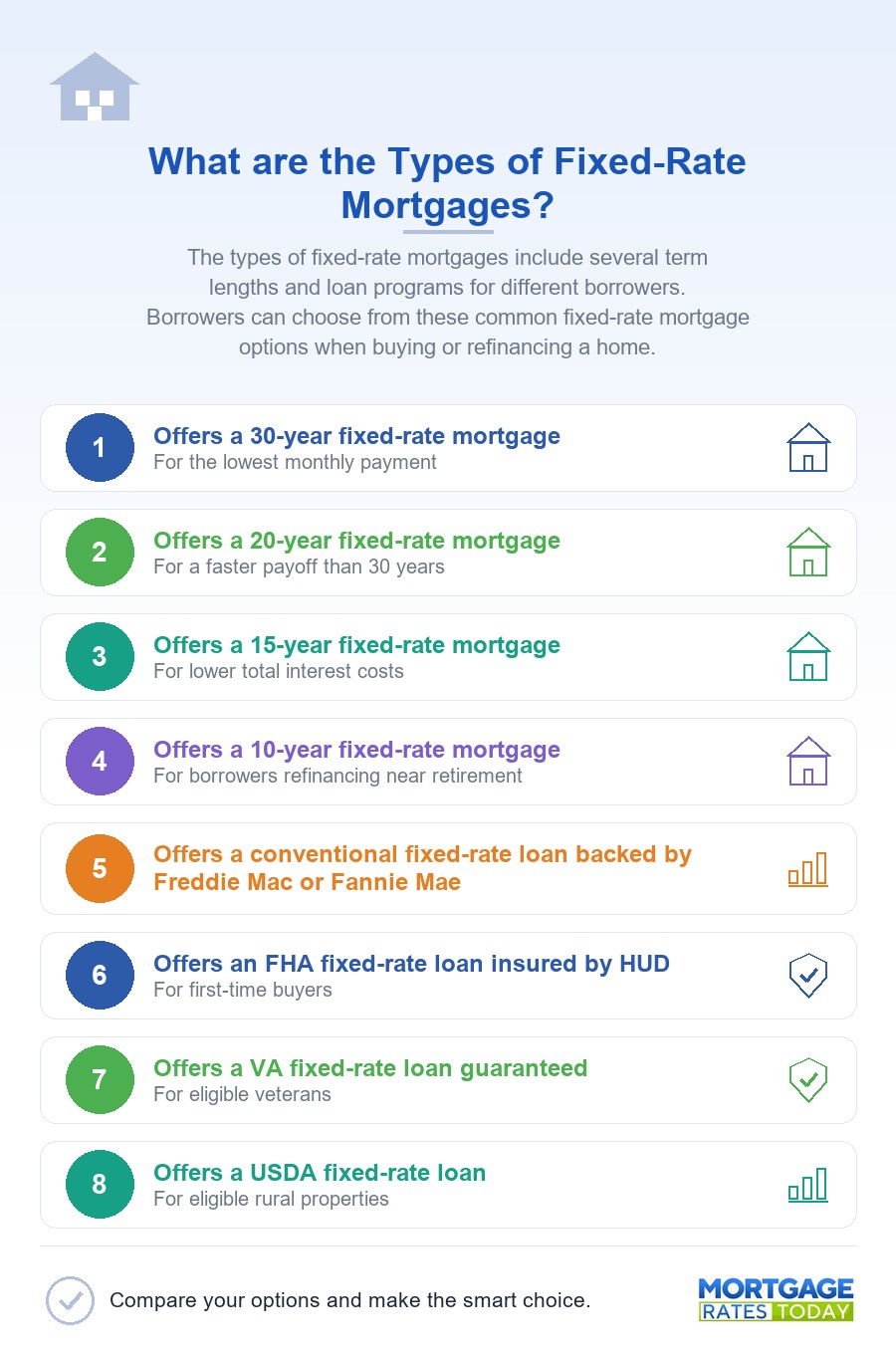
The types of fixed-rate mortgages include several term lengths and loan programs for different borrowers. Borrowers can choose from these common fixed-rate mortgage options when buying or refinancing a home.
- Offers a 30-year fixed-rate mortgage for the lowest monthly payment
- Offers a 20-year fixed-rate mortgage for a faster payoff than 30 years
- Offers a 15-year fixed-rate mortgage for lower total interest costs
- Offers a 10-year fixed-rate mortgage for borrowers refinancing near retirement
- Offers a conventional fixed-rate loan backed by Freddie Mac or Fannie Mae
- Offers an FHA fixed-rate loan insured by HUD for first-time buyers
- Offers a VA fixed-rate loan guaranteed for eligible veterans
- Offers a USDA fixed-rate loan for eligible rural properties
Comparing loan terms and interest rates side by side helps borrowers pick the right fixed-rate mortgage.
What is the Benefit of a Fixed-Rate Mortgage?
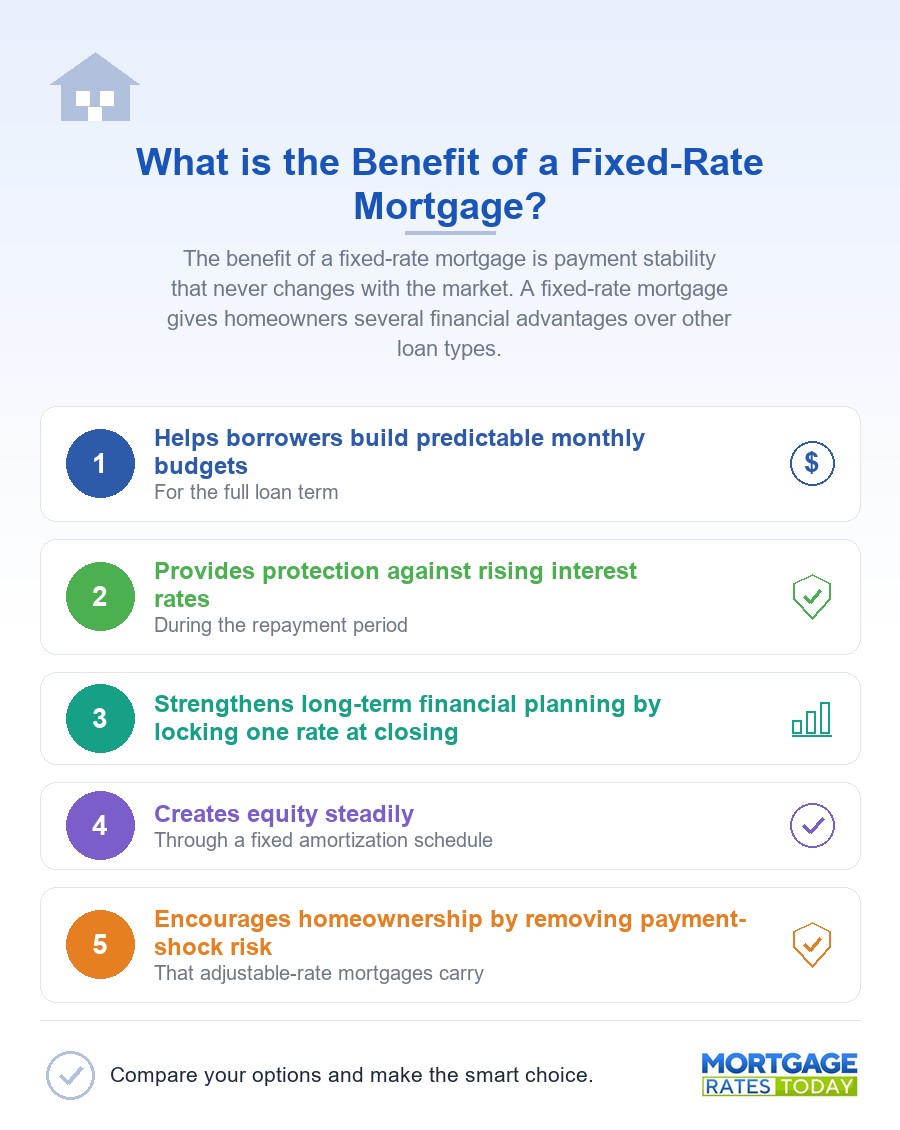
The benefit of a fixed-rate mortgage is payment stability that never changes with the market. A fixed-rate mortgage gives homeowners several financial advantages over other loan types.
- Helps borrowers build predictable monthly budgets for the full loan term
- Provides protection against rising interest rates during the repayment period
- Strengthens long-term financial planning by locking one rate at closing
- Creates equity steadily through a fixed amortization schedule
- Encourages homeownership by removing payment-shock risk that adjustable-rate mortgages carry
Work
How Does a Fixed-Rate Mortgage Work?
A fixed-rate mortgage works by combining one interest rate with a set amortization schedule. The lender calculates a monthly payment that covers both principal and interest across the full term. Early payments apply mostly toward interest, and later payments apply mostly toward principal. As per the Consumer Financial Protection Bureau, a fixed-rate mortgage’s interest rate and payment never change for the entire loan term, unlike an adjustable rate mortgage. Property taxes and homeowners insurance often get included in the monthly payment through an escrow account.
Importance
What is the Importance of a Fixed-Rate Mortgage?
The importance of a fixed-rate mortgage lies in shielding household budgets from rate swings. Rising rates cannot raise a locked payment, so families can plan other expenses with confidence. According to FHFA researchers Batzer, Coste, Doerner, and Seiler, every one percentage point that market rates exceed a homeowner’s locked rate cuts the odds that borrower sells by 18.1%. That lock-in effect prevented an estimated 1.72 million home sales nationwide between 2022 and 2024. A fixed-rate mortgage therefore shapes both household budgets and broader housing market conditions.
Interest Rate
What is the Interest Rate on a Fixed-Rate Mortgage?
The interest rate on a fixed-rate mortgage depends on credit score, loan amount, and market conditions. As reported by Freddie Mac’s Primary Mortgage Market Survey, rates move weekly based on bond markets and lender risk. Conforming fixed-rate loans follow limits set by the Federal Housing Finance Agency each year, while conventional loans, jumbo loans, and government-backed loans all price fixed rates differently. The table below compares recent national average rates for the two most common fixed-rate mortgage terms.
| Loan Term | Week of July 23, 2026 | One Year Earlier |
|---|---|---|
| 30-year fixed-rate mortgage | 6.58% | 6.74% |
| 15-year fixed-rate mortgage | 5.96% | 5.87% |
Borrowers with a credit score of 740 or higher, and a loan-to-value ratio at or below 80%, typically qualify for the lowest advertised rate apr.
Difference Between A 15-year And 30-year
What is the Difference Between a 15-Year and 30-Year Fixed-Rate Mortgage?
The difference between a 15-year and 30-year fixed-rate mortgage is term length and total interest paid. A shorter term charges a lower rate but raises the required monthly payment. As noted by Freddie Mac data, the 15-year fixed-rate mortgage typically prices below the 30-year fixed-rate mortgage by roughly half a percentage point. The comparison below assumes a $400,000 loan amount at the July 2026 average rates.
| Loan Term | Rate | Monthly Payment | Total Interest Paid |
|---|---|---|---|
| 30-year fixed-rate mortgage | 6.58% | $2,552 | $518,720 |
| 15-year fixed-rate mortgage | 5.96% | $3,364 | $205,520 |
Borrowers who can afford the higher payment save more than $300,000 in interest by choosing the shorter loan term.
Credit Score Is Needed
What Credit Score is Needed for a Fixed-Rate Mortgage?
The credit score needed for a fixed-rate mortgage starts around 620 for conventional loans. Minimum credit score requirements vary by fixed-rate loan program.
- Requires a 620 credit score for most conventional fixed-rate mortgages
- Requires a 580 credit score for an FHA fixed-rate loan with 3.5% down
- Requires a 500 credit score for FHA fixed-rate loans with 10% down
- Requires no set minimum for VA fixed-rate loans, though lenders often prefer 620
- Requires a 740 credit score to access Freddie Mac’s best advertised rate
Down Payment
What is the Down Payment for a Fixed-Rate Mortgage?
The down payment for a fixed-rate mortgage ranges from zero to twenty percent of price. Down payment minimums shift depending on the fixed-rate loan program a borrower selects.
- Requires 3% down for a conventional fixed-rate mortgage with mortgage insurance
- Requires 3.5% down for an FHA fixed-rate loan insured by HUD
- Requires 0% down for a VA fixed-rate loan for eligible veterans
- Requires 0% down for a USDA fixed-rate loan in eligible rural areas
- Requires 20% down to avoid private mortgage insurance on a conventional loan
Closing Costs Come
What Closing Costs Come With a Fixed-Rate Mortgage?
Closing costs on a fixed-rate mortgage typically total two to five percent of the loan amount. Lenders itemize these charges on the Closing Disclosure three days before signing. As cited by the Consumer Financial Protection Bureau’s mortgage-shopping guidance, comparing quotes from multiple lenders can save borrowers thousands of dollars in closing costs. Larger loan amounts often carry higher total closing costs even at the same percentage rate.
| Closing Cost Category | Typical Range |
|---|---|
| Loan origination fee | 0.5% to 1% of loan amount |
| Appraisal and credit report | $400 to $700 |
| Title insurance and search | $700 to $1,200 |
| Discount points (optional) | 1% of loan amount per point |
Buying discount points at closing lowers the fixed-rate mortgage’s interest rate for the full loan term.
Amortization Work
How Does Amortization Work on a Fixed-Rate Mortgage?
Amortization on a fixed-rate mortgage spreads principal and interest across scheduled monthly payments. Early years apply most of each payment to interest, and later years flip that balance toward principal. As indicated by a standard amortization schedule, the table below shows how a $400,000, 30-year fixed-rate mortgage at 6.58% shifts over time.
| Loan Year | Interest Paid | Principal Paid |
|---|---|---|
| Year 1 | $26,190 | $4,434 |
| Year 15 | $20,780 | $9,844 |
| Year 30 | $1,120 | $29,504 |
A fixed-rate mortgage’s predictable schedule lets borrowers calculate their exact payoff date in advance.
Private Mortgage Insurance
What is Private Mortgage Insurance on a Fixed-Rate Mortgage?
Private mortgage insurance on a fixed-rate mortgage protects the lender when the down payment is small. Conventional fixed-rate loans require mortgage insurance whenever the down payment falls below 20%. As referenced by federal lending rules, a lender must automatically cancel mortgage insurance once the loan balance reaches 78% of the original home value. FHA fixed-rate loans include a separate mortgage insurance premium that can last the full loan term depending on the down payment size. Removing mortgage insurance lowers the fixed-rate mortgage’s total monthly payment.
Refinance
Can You Refinance a Fixed-Rate Mortgage?
Borrowers can refinance a fixed-rate mortgage to secure a lower rate or shorter term. Homeowners refinance a fixed-rate mortgage for several common reasons.
- Helps borrowers secure a lower rate when market pricing drops
- Shortens the loan term from 30 years to 15 for faster payoff
- Removes mortgage insurance once home equity reaches 20 percent
- Converts an adjustable-rate mortgage into a fixed-rate mortgage for stability
- Unlocks home equity through a cash-out refinance option
As outlined by Urban Institute research, the refinancable share of outstanding mortgages fell to just 3.1% in March 2025 as most fixed-rate holders had no financial incentive to refinance.
Rate Lock
What is a Rate Lock on a Fixed-Rate Mortgage?
A rate lock on a fixed-rate mortgage freezes the interest rate before closing occurs. Lenders typically provide lock periods between 30 and 60 days while the loan processes. Locking early protects borrowers if rates rise before closing, though it forfeits savings if rates fall instead. As stated by mortgage industry guidance, some lenders provide a float-down option that captures a lower rate if the market improves. Paying discount points during the lock period can further reduce the fixed-rate mortgage’s starting interest rate.
How Does a Fixed-Rate Mortgage Compare to an Adjustable-Rate Mortgage?
A fixed-rate mortgage compares to an adjustable-rate mortgage mainly through rate stability over time. Lenders sometimes label this loan type a mortgage ARM in marketing materials. The two loan types differ in several important ways for borrowers weighing their options.
- Keeps one fixed rate for a fixed-rate mortgage across the entire term
- Adjusts periodically for an adjustable-rate mortgage after an introductory rate period
- Offers lower starting payments on an adjustable-rate mortgage than on a fixed-rate mortgage
- Carries payment-shock risk on an adjustable-rate mortgage when rates reset higher
- Suits long-term homeowners best when compared with a short-term adjustable-rate mortgage buyer
In accordance with ICE Mortgage Technology data, ARMs reached nearly 21% of 2025 originations, the highest share in three years, while fixed-rate loans still covered the rest.
Choosing between a fixed-rate mortgage and other loan types depends on how long a borrower plans to stay and how much rate certainty they need. Mortgage Rates Today compares live rates from lenders nationwide, making it simple for shoppers to find the fixed-rate mortgage that fits their budget without guesswork. The team tracks Freddie Mac’s weekly survey, current credit score tiers, and closing cost trends every day. Visit Mortgage Rates Today to compare 30-year and 15-year fixed-rate mortgage offers side by side, lock in a competitive rate, and buy or refinance with confidence.
